| Current Poll |
Are you for armed guards at schools?
View Results
|
|
Baldwin still instructing Jerry Baldwin spent 26 years in the coaching profession, including three years at Ferriday High. But it doesn't compare to the instruction he gives nowadays on a daily basis.
"I'm still coaching, but it's a different game," Baldwin said. "I've always been a life coach even when I was coaching the game."
After a tumultuous tenure at Louisana-Lafayette, Baldwin went full-time into the ministry as the founder of New Living Word Ministries, which began on October 25, 1992 in what was then known as the Holiday Inn Hotel In Ruston.
There were around 20 people in attendance at the first service at New Living Word Ministries. As time went on the attendance multiplied. The membership increased so much that in March of 1994 New Living Word Ministries moved to its current location at 1900 W. Barnett Springs Road in Ruston.
The newly purchased property included a sanctuary seating over one hundred people, several offices, several classrooms, and a kitchen. Membership increased so much that an overflow room was opened to accommodate the increase in numbers. As more and more people continued to come there grew a need for expansion.
In the summer of 2005 New Living Word Ministries began its Restoration Ministry to meet the needs of those who needed assistance with getting their lives back on track. The Restoration Ministry expanded in the Fall of 2005 in response to Hurricane Katrina. Many people were housed at the Family Life Center.
In 2007 a home for men and a home for women were opened to house the homeless men, women, and children who are a part of the restoration ministry.
In March 2008 an additional restoration home was opened.
"As a matter of fact, I have some guys from Ferriday and Vidalia helping me," Baldwin said. "Nathaniel Williams is over one of the facilities and Cedric Morgan of Ferriday and Otis Fair of Vidalia are involved."
In 2006 the ministry expanded to Jonesboro.
New Living Word currently has over 30 different ministries designed not only to meet the needs of the people within the church but to reach beyond the four walls to the surrounding community.
But turning things around is nothing new for Baldwin. After a standout high school career at North Natchez High School where he was named Athlete of the Year at the school in 1971, Baldwin signed a football scholarship with Mississippi Valley State where he lettered for three years
He then went into the coaching business, taking an assistant coaching job at Zachary High School in 1975.
Baldwin was head coach at Davidson High School in St. Joseph for three years before accepting the head coaching job at Ferriday in in 1979.
The Trojans went without a win in 1978.
Baldwin, 58, led Ferriday to a 2-8 season his first year in '79.
"I was very confident we could turn the program around," Baldwin said. "I saw the potential and felt what I was doing was right. I knew God put me in Ferriday and would make sure it would be all right. It wasn't about the ability, but the attitude needed to be changed. We just needed to get organized and instill a new thought process. If you think you are a loser, then you are going to be a loser. We began getting them to think like winners."
The next year, Ferriday went 7-3, finishing 4-2 in District 3-AAA. The Trojans defeated Pineville in their final game, 6-0. But Ferriday had to beat Pineville by at least 12 points to earn a playoff spot. Pineville and Tioga, both also 4-2, advanced to the playoffs.
Baldwin was still named 3-AAA Coach of the Year.
Trojan fans got an indication early what 1981 would bring as the Trojans dominated Sicily Island 52-6 in its opener.
Ferriday blitzed McCall 52-14 as the Trojan defense, led by Walter Johnson at nose guard, held the Dragons to 25 yards rushing and 47 passing.
The Trojans opened district play with a 20-0 shutout of Caldwell, holding the Spartans to 65 total yards.
Ferriday handed Vidalia its first loss of the season the following week, defeating the Vikings 30-16.
Following an open date, Ferriday finished the regular season unbeaten with a 50-13 win over Block, holding the Bears to 115 yards.
The Trojans beat Jonesboro-Hodge 42-11 in a first round playoff contest, holding the Tigers to minus-19 yards rushing and 147 passing.
Williams scored four touchdowns in the contest for Ferriday.
Ferriday had to overcome a 12-6 halftime deficit to Springhill in its second round game, defeating the Lumberjacks 18-12 to advance.
Ferriday defeated St. Louis of Lake Charles 28-7 in the quarterfinals, holding the Saints to 126 rushing yards and 26 yards through the air.
That set up a semifinal classic contest with Class 2A power John Curtis, which was also unbeaten and the two-time defending state champion, having beaten Patterson 28-0 in the 1979 state title game and Jonesboro-Hodge 21-3 in the 1980 title game.
Ferriday actually jumped out to a 16-7 first quarter lead, but the Patriots came back to lead 28-24 at halftime.
The Patriots led 36-24 after three quarters and both teams scored six points in the final quarter as the scoreboard showed a 42-30 final in a game played before a jam-packed crowd, including LSU head football coach Jerry Stovall.
After the game, John Curtis school founder John Curtis Sr., whose son John Curtis Jr., was the head coach, told Baldwin, "You are the best we've played all year. We have played some quad-A teams and none of them matched your team."
Curtis beat E.D. White 21-17 the following week for its third straight championship.
"J.T. and I became good friends," Baldwin said. "He told me after the game that it was the greatest high school game he had ever been involved with. It was a great game and very memorable. Both teams played their hearts out. Our kids gave all they had. I thought one call affected the outcome. When Bobby Ray Thompson's touchdown was called back, it kind of knocked the wind out of us."
Ferriday went 10-2 in 1982, losing to Winnfield 32-14 in the Class AA state quarterfinals. The only other loss was to North Natchez.
Baldwin joined A.L Williams' staff at Louisiana Tech in 1983.
"I knew it was time to go," Baldwin said. "I did at Ferriday what I was sent to do. It was tough leaving. I was attached to the kids and the community. I love Ferriday."
Former Sicily Island High All-State football player Joe Raymond Peace was named head coach at Tech after the 1987 season and made Baldwin his assistant head coach in 1988.
"That was a great experience," Baldwin said. "We had some great teams and I got the chance to coach some great kids. But, just like at Ferriday, my time was up."
Baldwin joined Curley Hallman's staff at LSU in 1993 as a linebacker coach, turning down a head coaching position at Southern.
The Tiger defense went from last in the SEC in 1993 to first in the league in 1994.
Baldwin recruited the New Orleans area, a tough job because New Orleans high school coaches developed a rift with LSU when Mike Archer was head coach.
"There was some bad blood between LSU and New Orleans high school coaches," Baldwin said. "I think I was able to restore that relationship."
But Hallman's tenure was not a good one. During four seasons in Baton Rouge, he compiled the lowest winning percentage (min. 10 games) in school history at .364. His overall record was 16-28.
During Hallman's first season in 1991, several of Hallman's football players were accused of instigating a fight with LSU men's basketball players, including All-American Shaquille O'Neal, in Broussard Hall, LSU's athletic dormitory, two days prior to the Tigers' contest with Mississippi State.
LSU started the 1991 season with one-sided losses to Georgia (31-10) and Hallman's alma mater, Texas A&M (45-7), and finished 5-6. The season marked the second time LSU suffered three consecutive losing seasons and the first time since 1954 to 1956.
The beginning of the end for Hallman came on September 17, 1994 at Jordan-Hare Stadium against Auburn.
LSU led 23-9 early in the fourth quarter, and the Bayou Bengals were in good position to end Auburn's 13-game winning streak. But LSU quarterback Jamie Howard threw two interceptions that were returned for Auburn touchdowns, tying the game.
LSU regained the lead with a field goal, but when the Bayou Bengals were trying to run out the clock, Howard threw his fifth interception of the game, and incredibly,
Auburn returned the pick for another touchdown, giving the home team a 30-26 lead. LSU drove into Auburn territory in the game's waning seconds, but Howard's sixth interception sealed the win for Auburn.
Three days after a 20-18 loss to Southern Miss in front of a half-empty Death Valley, LSU athletic director Joe Dean fired Hallman after he refused to resign. Despite this, Hallman coached the Tigers in the final two games of 1994, beating Tulane and Arkansas to finish at 4-7 for the year.
Gerry DiNardo then replaced Hallman and Baldwin stayed with DiNardo until 1998.
"I never second-guess the head coach," Baldwin said. "He did things he wanted to do, but unfortunately it was not good enough. But I was a very loyal assistant coach, even if I may have looked at some things with a different point of view."
Baldwin was named head football coach at Southwestern Louisiana (now Louisiana-Lafayette) in 1999, becoming the first black head football coach at any major Louisiana university.
Baldwin went 2-9 his first season, 1-10 in 2000 and 3-8 in 2001. He was terminated at the end of that season.
"It was a tough situation," Baldwin said. "The program was obviously down, but I was very confident I was there at the right time and had the support of the fans. The previous administration counted on junior college players. I believed in getting kids out of high school and red-shirting them. And that's what the administration told me they wanted. I think we were on track to be competitive and academically we were improving. But they cut it short. I had seven or eight players in the NFL, including Charles Tillman of the Bears and Ike Taylor of the Steelers."
Baldwin filed a lawsuit, claiming that the University of Louisiana at Lafayette fired him because of his race, not because his teams lost 80 percent of their games.
"It was the right thing to do," Baldwin said. "I never got any negative evaluation or comments from anybody in administration. I was proud of the fact we did things the right way. Making that change was racial and you can't do that in America to people. I forgive them, but I have to move on. I never had any hard feelings toward anybody.
Baldwin originally won a $2 million judgment in a lawsuit in 2007 claiming that the University of Louisiana at Lafayette fired him because of his race, not because his teams lost 80 percent of their games.
Jurors found that Jerry Baldwin's race wasn't the only reason he lost the job, but was among the reasons. University officials broke his contract and inflicted emotional distress through negligence, according to the jury of six whites and six blacks.
Jurors took nearly 10 hours to work their way through a complicated verdict form.
Jurors voted 10-2 to award Baldwin $500,000 for general damages, including emotional distress; $600,000 for past lost wages; $900,000 for future lost wages, and $2,676 for special damages.
But two years later, a state appeals court threw out the $2 million verdict. State 1st Circuit Court of Appeal cited problems with jury selection, confusion over the jury verdict form and an expert witness who should not have been allowed to testify.
A three-judge appeals panel wrote that "a fair, impartial resolution requires a new trial."
In the first trial, the judge refused to dismiss a black woman juror who said she had been subjected to racial discrimination by a white supervisor while working as a state employee.
ULL attorneys said her experience could lead to a bias in favor of Baldwin, but the judge denied the challenge to the juror when Baldwin's attorneys argued the university wanted to dismiss the juror because she was black.
The woman had said she could put her experience aside and render a fair decision, but the appeals panel wrote the university had a "reasonable basis" to suspect she might not.
The appeals court also found Johnson wrongly granted "expert witness" status to a man who testified about how being fired might make it difficult for Baldwin to obtain another coaching job.
The appeals judge ruled that the man offered only a personal view unsupported by any "indicia of reliability."
"It's still in litigation," Baldwin said. "It was scheduled for the fall, but now it has been postponed to next summer."
For now, Baldwin, the son of a Baptist minister, is fully immersed in his ministry.
"I was involved in the ministry even when I was at Ferriday," Baldwin said. "When I was at LSU, I was going back and forth to Ruston. Coaching in college prepared me what what I am doing now. He prepared me for this position. There is a tremendous parallel in leadership. I didn't change, He changed it."
Baldwin and wife Juliet have two daughters and four grandchildren.
Thirty-six-year-old Kimberly's 10-year-old son, Julian, scored two touchdowns in a youth championship football game in Atlanta. The 8-year old also plays youth football.
Kia, 30, has twins who are 16 months old and living in Ruston.
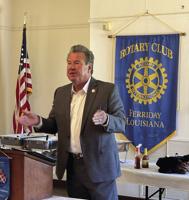
Baldwin, who spoke at a Word of Faith service at the Delta Music Museum Arcade on Dec. 18 for former Ferriday High boys basketball coach Robert Cade, said he plans on returning to Ferriday.
"I am going to walk the streets of Ferriday and spend a couple of hours cleaning them up," he said. "Everyone who wants their lives changed can get in the van and come back with me." |
|
| Frank Morris Murder Series |
|
|